
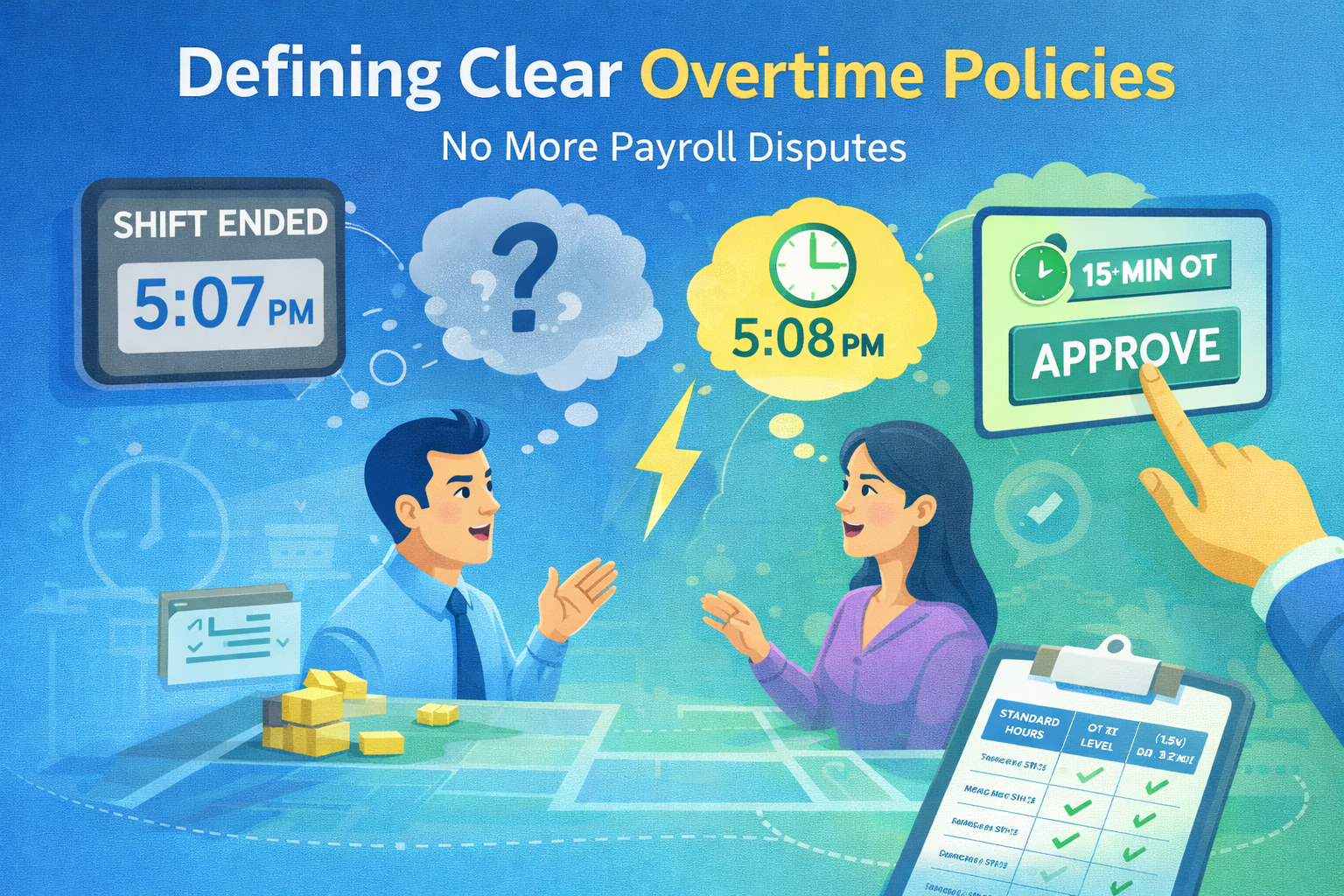
Overtime disagreements usually stem from "the gray area"—that fuzzy space between when a shift officially ends and when an employee actually leaves. Without clear rules, payroll becomes a weekly negotiation.
To fix this, you need a policy that is transparent and a system that applies those rules consistently without human bias.
1. Define What Counts (and What Doesn't)
Consistency starts with a mathematical definition. If you haven't defined your thresholds, you're leaving it up to interpretation.
-
Shift-Based Overtime: Does overtime start the second a shift ends? Or is there a 10-minute "grace period" for tidying up?
-
Threshold-Based Overtime: Perhaps overtime only kicks in after 8 hours in a single day, or 40 hours in a week.
-
The Power of Rounding: Manual calculations often lead to "rounding up" in the employee's favor. Applying a consistent 15-minute rounding rule (e.g., 5:07 PM rounds to 5:00 PM, while 5:08 PM rounds to 5:15 PM) ensures fairness across the entire team.
2. Use Approvals to Prevent "Time Drift"
You don't want to block your team from working hard, but you do want to prevent "drift"—those extra 15 minutes of chatting or slow packing that add up to hours of unauthorized pay.
-
The 30-Minute Threshold: Set a rule where minor overages (e.g., under 15 minutes) are flagged but paid, while anything over 30 minutes requires a manager’s digital "thumbs up."
-
Proactive Management: This allows managers to address genuine needs (like a late delivery) while catching recurring issues before they hit the payroll export.
3. Make Payroll Exports Predictable
The payroll team shouldn't have to play detective. If they have to manually split a 45-hour week into 40 hours of "Base" and 5 hours of "OT," the system has failed.
-
Categorized Exports: Your system should automatically export data with separate columns: Standard Hours, OT Level 1 (1.5x), and OT Level 2 (2x).
-
Anomalies & Notes: Every minute of overtime should be linked to a reason code or a manager's note. This makes the data audit-proof and reduces the back-and-forth emails between HR and Department Heads.
WorkClocking Tip: Set it and Forget it
The goal of a digital system is to remove the "human" element from the calculation. Configure your rounding, grace periods, and approval thresholds in your settings once. This ensures that every employee is treated exactly the same, building a culture of trust and financial predictability.