
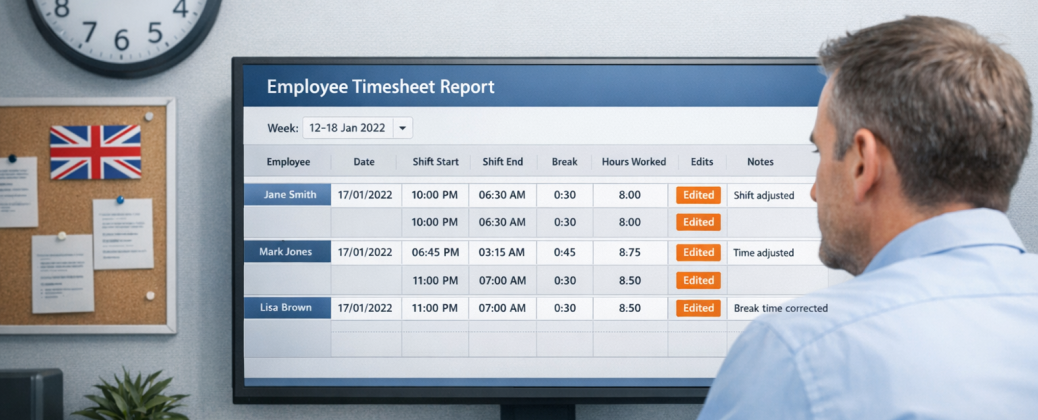
Why this matters now
Missed clock-outs, unclear rules on travel time and overnight shift handling are frequent causes of payroll mistakes and National Minimum Wage (NMW) or National Living Wage (NLW) non-compliance. Small errors compound across pay runs and can trigger HMRC enquiries, backpay liabilities and penalties. This post gives practical, operational steps UK employers can adopt immediately.
Key risks to watch
- Underpaying staff in a pay reference period, leading to NMW/NLW breaches.
- Incorrect calculation of hours for overnight shifts (rest break and weekly average rules).
- Unrecorded travel time that should be treated as working time.
- Poor audit trails — missing evidence for clock corrections or manager adjustments.
Immediate actions for missed clock-outs
- Create a standard correction workflow: employee notifies manager → manager verifies (rota, CCTV, witness) → corrective entry added within payroll cut-off with reason and approver details.
- Require short written confirmation from the employee when possible (email/SMS) to support the correction.
- Log every manual change in a tamper-proof audit trail (who, when, why, original entry).
- Pay provisional corrections in the next pay run and reconcile in a timely manner to avoid persistent underpayment.
Overnight shifts: calculation and compliance tips
- Record actual start and finish times. For recurring shifts, keep rotas and contracts that reflect expected patterns.
- Check rest-break entitlements under the Working Time Regulations and ensure they're deducted or paid appropriately.
- For NMW assessment, calculate pay across the whole pay reference period (not just single night shifts) and include all elements that count as pay.
Travel time: when to include it as working time
- Home-to-work travel is generally not working time. Travel during the working day (e.g., between sites), travel required as part of duties, or travel for a customer visit usually is working time and must be paid.
- Be explicit in policy about which travel is paid and how it is recorded (time in/out, mileage, company transport logs).
- Where payment is by allowance, ensure it does not mask an NMW shortfall — allowances can be included in NMW calculations only if they are compulsory and documented.
Practical policies and templates (examples)
Include these points in your staff handbook and shift briefings:
- Report missed clock-outs within 24 hours to a named manager.
- Managers must verify and record corrections with evidence (rota, witness, CCTV) and log the adjustment reason.
- Travel time that counts as working time must be logged in the timekeeping system and will be paid in the next payroll.
- Overtime and overnight premiums: outline calculation method and show sample payslip entries.
Sample missed clock-out workflow
- Step 1: Employee alerts manager via standard form/email.
- Step 2: Manager checks rota, CCTV or colleague statement within 48 hours.
- Step 3: Manager applies correction in the time system, adds justification and attaches evidence.
- Step 4: Payroll receives flagged correction before cut-off for validation and payment.
- Step 5: Record retained in audit log for a minimum retention period (see HMRC guidance).
Audit checklist for payroll and timekeeping
- Do you have a tamper-proof audit log for all time edits?
- Are policies clear on which travel counts as working time?
- Are overnight shift payments, rest breaks and working time averages documented and applied?
- Are correction workflows fast, evidence-based and consistently followed?
- Do you retain supporting records for HMRC/inspectorate review?
Technology & controls
Use time-tracking tools that:
- Lock raw punch data and record edits with user IDs and timestamps.
- Support mobile/location verification for remote/field staff.
- Provide exception reporting (missed outs, long shifts, low-hours risks) and integrate with payroll to reduce manual handoffs.
Handling disputes and correcting historic underpayments
- Investigate promptly and keep staff informed. If underpayment is confirmed, calculate backpay across the relevant pay reference periods and correct via payroll.
- Document remedial steps and publish any changes in policy to prevent recurrence.
- Seek HR/payroll or legal advice for complex cases (e.g., large group underpayments or long-running errors).
Quick checklist for employers
- Publish and train on a clear missed-clock-out policy.
- Ensure time systems provide immutable audit trails.
- Decide and document which travel time is paid.
- Regularly run exception reports and resolve before payroll cut-off.
- Retain evidence to demonstrate compliance with NMW and Working Time rules.
Further guidance
This post summarises operational steps — consult HMRC and ACAS resources or your payroll/HR adviser for case-specific guidance and current statutory detail.