
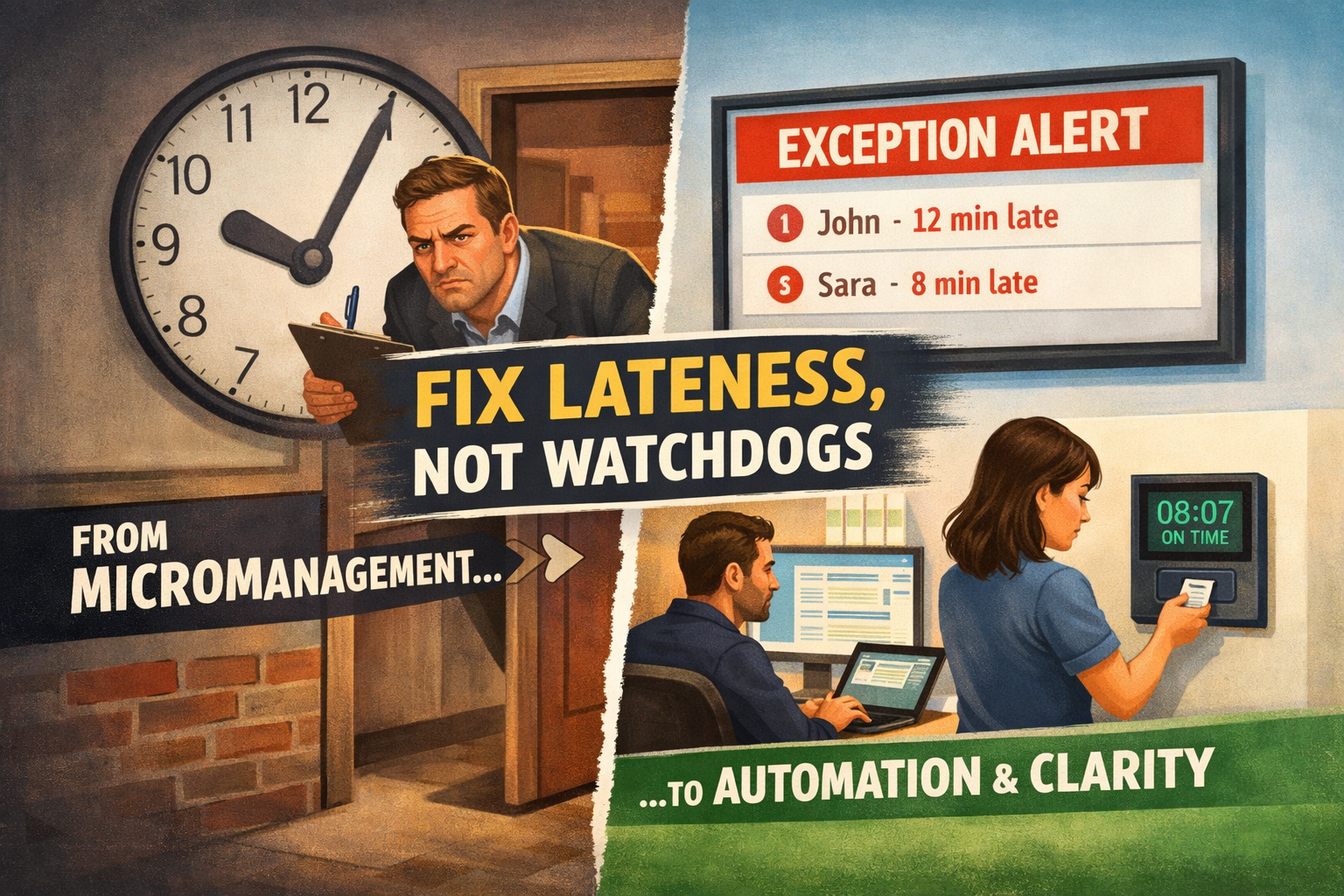
Micromanagement is often a symptom of a system that isn't working. When managers feel they have to "watch the clock" for every employee, it usually means the underlying rules are either too rigid or non-existent.
Reducing lateness isn't about standing by the door with a clipboard; it’s about creating a transparent, automated framework that makes expectations clear and enforcement invisible. Here is how to elaborate on those strategies.
Lateness is rarely a result of employees trying to "cheat" the system. More often, it stems from a lack of clarity. If one manager ignores a 5-minute delay while another writes it up, the inconsistency creates resentment.
To fix lateness, you need to move from surveillance to systematization.
1. Set Rules That Reflect Reality
Expectations only work when they are consistently achievable. If your shift rules are too punishing, employees stop trying to be on time the moment they realize they’re already one minute late.
-
The Grace Window: A 5-minute grace window is a powerful psychological tool. It accounts for the "elevator delay" or the "parking hunt." It signals that you value their time, but also expect them to be at their post ready to work.
-
Rounding That Works: Use rounding to simplify payroll, but ensure it’s balanced. If you round to the nearest 15 minutes, employees know there is a specific "cutoff" point.
-
The Late Threshold: Define what "late" actually means for a disciplinary conversation. Is it 1 minute? 10 minutes? By setting a threshold (e.g., more than 7 minutes late triggers a flag), you allow for human error while highlighting genuine patterns.
2. Use "Exception Management" Instead of Surveillance
The biggest time-waster for any manager is reviewing a list of 50 employees who all arrived on time just to find the two who didn't. This is where most micromanagement happens.
-
The Exception List: A modern system should only show you the exceptions. If 48 people clocked in within the grace window, their names shouldn't even cross your desk. You only want to see the two people who fell outside the rules.
-
Scalability: Surveillance doesn't scale. A manager can watch 5 people, but they can't watch 50. Exception reporting allows one manager to oversee a massive team effectively because the system does the filtering for them.
-
Neutrality: When the system flags a late arrival based on pre-set rules, it removes the "personality" from the conflict. It isn't the manager being "mean"—it’s the system noting a deviation from the agreed-upon policy.
3. Behavioral Feedback Loops
When you have a clean "Today" dashboard, managers can address lateness immediately and privately.
-
The "Same-Day" Fix: A quick, "Hey, I saw you were 15 minutes late today, everything okay?" is much more effective than a disciplinary meeting two weeks later when the employee can't even remember why they were delayed.
-
Spotting Recurring Issues: Automated reporting allows you to see if an employee is always 10 minutes late on Tuesdays. This might reveal a childcare or transit issue that can be solved with a simple shift adjustment, rather than a reprimand.
WorkClocking Tip: Be Transparent
The best way to reduce lateness is to give employees access to their own data. When staff can see their own "Late" flags in real-time on their app, they often self-correct before a manager ever needs to say a word.